
From 4 Weeks to 2 Hours: How Angelonia AI is Transforming Preclinical Study Reports
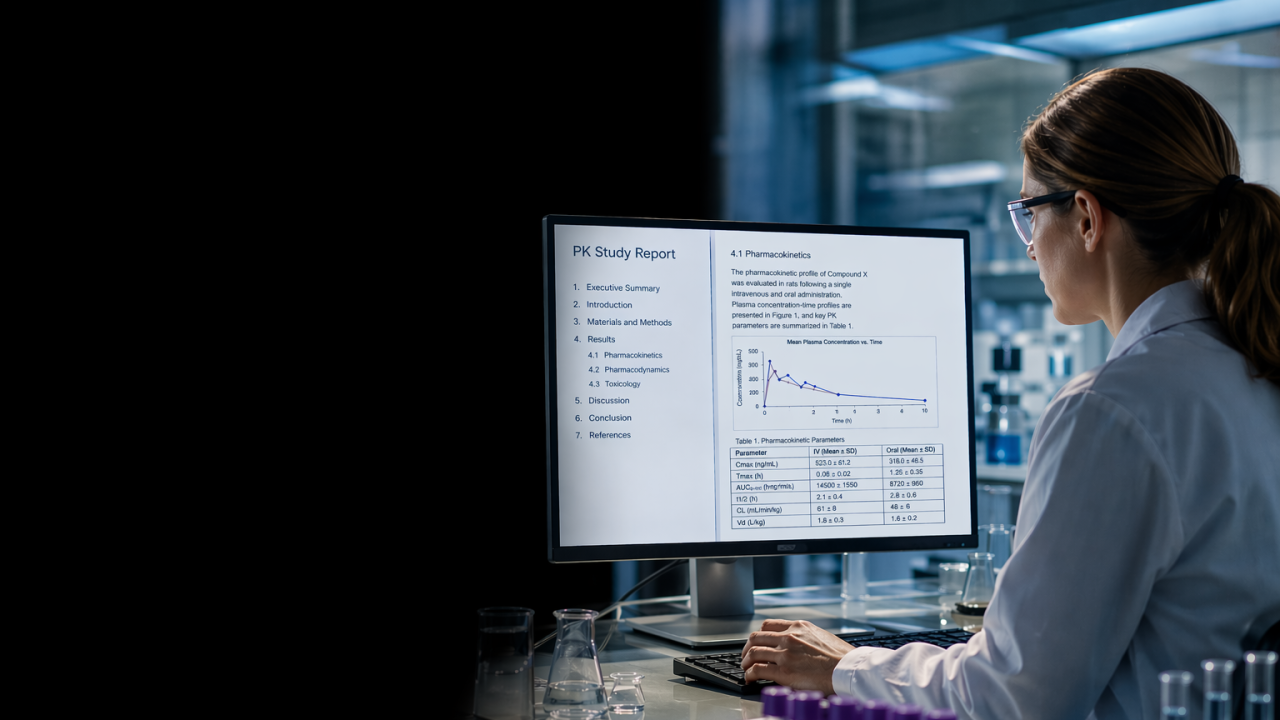
Scientists Shouldn't Be Spending 30% of Their Time Writing Reports
In preclinical drug discovery and development state, writing a single technical report — the kind that summarizes pharmacokinetics, pharmacodynamics, toxicology, or CMC data — typically takes 1 to 3 weeks to author, plus another 1 week for review and revision. That's a month of calendar time, for one report.
Here's what's striking: a meaningful chunk of that time has nothing to do with science. It's what we at Angelonia AI call the translation layer — moving data from spreadsheets into narrative prose, reconciling inconsistencies between tables, figures, and text, drafting and redrafting across sections, and cycling through multi-stage reviews.
Studies suggest scientists spend 20–30% of their working time on documentation tasks like these. That's not a minor inefficiency. At a small biotech or CRO, that's potentially months of cumulative scientific capacity absorbed by paperwork every year.
Angelonia AI was built specifically to solve this problem.
The problem isn't capability. It's workflow design.
The scientists doing this work are highly trained. They understand the data. They know what the story should be. But the process of getting that story onto the page — in the right format, with the right language, aligned with regulatory expectations — is tedious, time-consuming, and largely manual. This is the exact gap the Angelonia AI platform is designed to close.
Our AI-native documentation platform can:
Transform structured experimental data directly into narrative draft sections
Generate documents already aligned with regulatory publishing formats
Let scientists focus where they add the most value: review, validation, and scientific judgment
And critically — Angelonia AI integrates into the tools scientists already use. Microsoft Word, OneDrive, SharePoint, Egnyte co-editing. Not a foreign platform demanding new workflows. Angelonia AI working inside familiar ones, on day one.
What Angelonia AI looks like in practice
One of our active clients, Vincere Biosciences, reports that Angelonia AI was applied to real preclinical report preparation and the results were notable:
Report preparation time dropped from approximately 3 weeks to under 2 hours
First drafts received an average rating of 9 out of 10 from scientific reviewers
Human review and sign-off remained a required — and valued — step throughout
A well-constructed system that fits how scientists actually work — which is what Angelonia AI is built to do — delivers meaningfully better outcomes than a powerful tool bolted awkwardly onto an existing process.
Why Angelonia AI, and why now
AI adoption is accelerating rapidly, yet specialized life science documentation remains a critical bottleneck. Generic large language models are still insufficient for producing high-quality outputs in this highly specialized, regulated domain. Our multi-agent documentation platform is purpose-built for the life science vertical preclincial (PK/PD/Tox), CMC.
High-quality first drafts
Full data traceability
Compliance-readiness from the start
Human-in-the-loop validation
The science is still done by scientists. Angelonia AI gives them their time back.
As timelines compress and submission expectations grow, the ability to move from data to document — quickly, accurately, and in a format regulators expect — will increasingly separate high-performing organizations from those still doing it the old way.
If your team is still spending weeks on reports that should take hours, give us a call.
